
Viewing Office Spaces in Cologne: What Matters During the Tour
A tour rarely leads to a “yes,” but it often leads to a “no.” Here’s what you should check in the space, what questions to ask about the building—and what you can expect from a good advisor. The second part is our internal guide. We’re making it public so you can hold us to it.

A site visit consists of four parts—and the most important one comes afterward
The appointment itself often lasts less than an hour. What makes it valuable happens before and after. Incidentally, there’s one more step before that: the needs assessment, during which space requirements and the requirements profile are determined.
-
01 Preparation
Identify the participants, obtain a floor plan, and have the list of questions and measuring tools ready. If you go into a meeting unprepared, you’ll see the space—but you won’t assess it.
-
02 Tour
Look first, then comment. A space makes an impression before anyone explains it—and that first impression is a piece of information that shouldn't be dismissed.
-
03 Check
Layout, building systems, ancillary spaces, parking spaces, surroundings. The checklist below takes you through the points that tend to get overlooked during the meeting in six steps.
-
04 Follow-up
A written summary for both sides: what was presented, what was agreed upon, and what remains open. Without it, you’ll end up negotiating based on memories later on.
Office Viewing Checklist
Property: _______________________________________ Floor: ______________
Date: ___________________ Participants: _______________________________
Bring this list with you to the appointment
Six quick rounds, five minutes. Go through it before the tour or check off items as they’re clarified during the walkthrough. At the end, you’ll receive a list of outstanding issues—to print out, take with you, or forward to us. Because these are precisely the questions that will later determine whether a space truly works.
You don’t have to ask everything yourself. We’ll ask the owner about the technical details—structural integrity, building systems, wiring, construction plans—on your behalf and document the answers in writing. The important thing is that nothing gets overlooked.
Step 1 of 6
Space and Layout
The figure in the property listing does not replace an on-site verification.
Step 2 of 6
Fittings and Building Services
Anything missing here will later become a point of negotiation—or a cost driver.
Step 3 of 6
IT and Electricity
Four points that can’t be answered without expert knowledge. Bring someone from your IT department—we’ll bring the questions.
Step 4 of 6
Adjacent Rooms and Access
The rooms no one thinks about during the tour—but that are used every day.
Step 5 of 6
Parking and Surroundings
Parking is rarely the first thing that comes to mind—and it’s often the point where things get complicated later on.
Step 6 of 6
Documents and Terms
What you should get out of the appointment—not just weeks later upon request.
Result
Your viewing results
This is a guide, not a definitive list—feel free to add items that matter to your business. What should be clarified before the first appointment is outlined on our page about needs analysis for office space; our guide to renting office space in Cologne outlines the next steps.
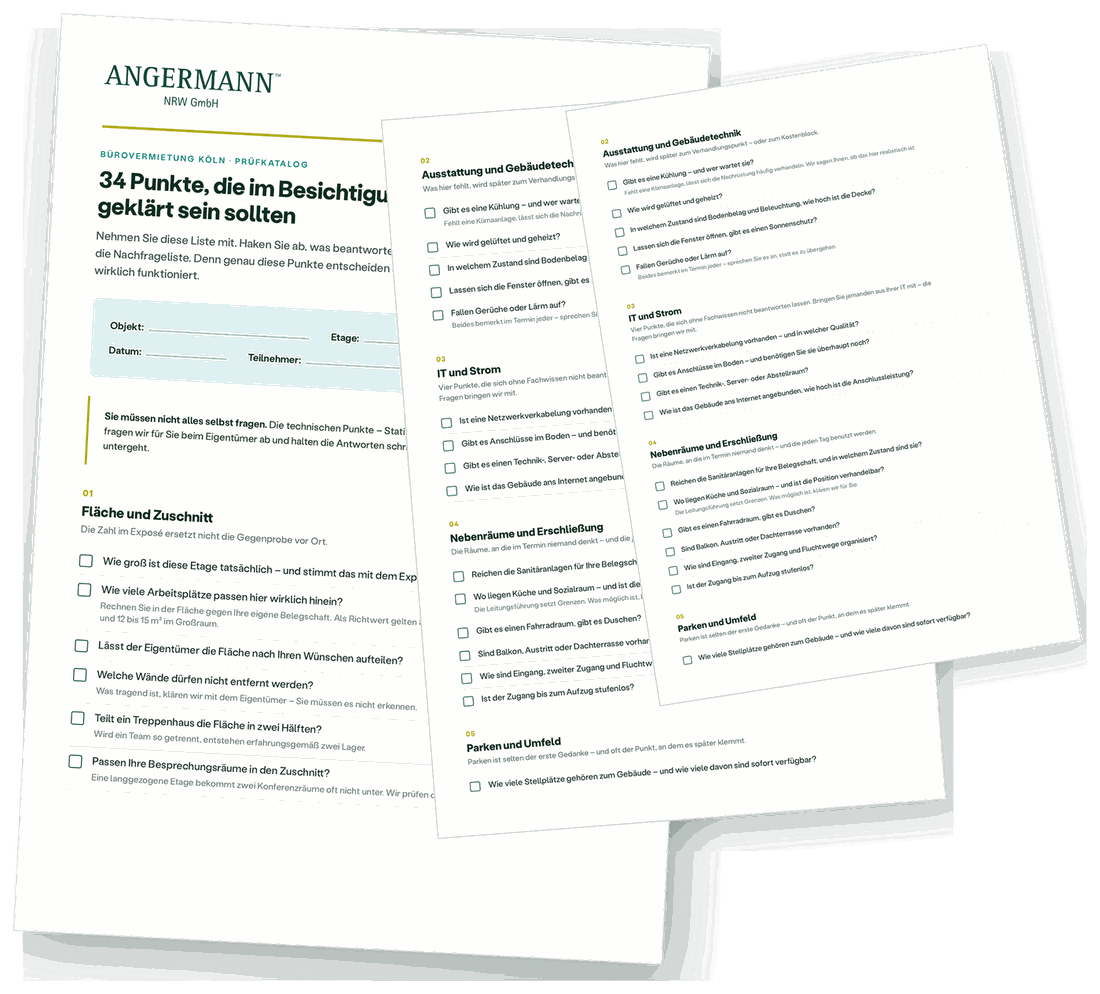
The 34 points as a PDF to take with you
Three pages to print out and check off, with fields for property, floor, date, and participants. Bring the checklist with you to the appointment and note down any outstanding issues—we’ll take care of the technical details.
Download the checklist
The download will start immediately after you submit the form. We use your information solely to process your request—it will not be shared with third parties.
What You Can Expect from Your Advisor
These three points are included in our internal guide for property viewings. They belong here because they help you recognize who you’re dealing with—whether it’s us or someone else.
-
He's there before you
The room is well-ventilated, the lights are on, and the space looks presentable: Anyone arriving with you hasn’t seen the space that day. And they know the names of all the participants because they asked beforehand who would be attending from your side—addressing people by name isn’t just a stylistic device; it’s a skill.
-
He takes the lead instead of following behind
The agent leads the way, introduces the parties to each other, and facilitates the meeting. What must not happen is for you and the owner to negotiate while the agent trails behind. And no one needs to explain to you what you can see for yourself—you can recognize a kitchen without being told.
-
He lists the shortcomings first
Trying to gloss over obvious weaknesses is the surest way to lose trust—they can see and sense what’s wrong anyway. A consultant first identifies the shortcomings and outlines solutions. And he doesn’t promise renovations for which the owner hasn’t approved funding.
Four No-Nos During a Property Tour
From the same internal guide—the cross-check. If you encounter this during the appointment, you’ll know where you stand.
-
Arriving later than you
Anyone who arrives after you won't have had a chance to air out the space, turn on the lights, or check its condition. They won't see the space itself, but rather what chance has left behind.
-
Hand Over the Moderation
You and the owner talk to each other, while the real estate agent trails behind. This means he’s not fulfilling the very role he’s there to play—and nothing said during the meeting is recorded by anyone afterward.
-
Renovations that no one has approved
How much the expansion will cost and who will pay for it
"We can change everything here"—a phrase often heard in this context, but one that has no basis in reality without the owner's approval. What gets renovated depends on the condition of the building and the budget—both of which must be clarified before any commitments are made.
-
Cell phone, clothes, car
Typing on your phone, unkempt clothes, a car full of paperwork where you first have to clear a seat for yourself: little things that no property listing can make up for. You need to give this one appointment your full attention.
How We Conduct Site Visits
What really matters during a tour is the experience on-site—that’s why we personally accompany every tour.
The area will be shown at the appointment
“Lighting, acoustics, the walk from the elevator to the desk—you can only really experience these things in person. That’s why I like to walk through each space myself, as often as it helps.”
We’ll prepare your property viewings—and summarize them for you.
From selecting properties to scheduling appointments to preparing written reports: We organize what you’ve seen and turn it into a basis for your decision. No obligation.

Leonard Albert
Bürovermietung, Einzelhandel
One site visit isn't enough
The decisive site visit is rarely the first one. The reason is simple: The first property doesn’t provide a benchmark. It’s only the second and third visits that reveal what’s actually available in your size range, location, and budget. In the case of the law firm from our practical example on needs analysis, the decision was made after the third site visit—and even after that, there were still more appointments to come.
Two floors in the same building can be completely different. During a single site visit, a smaller unit and a significantly larger one were viewed; the smaller one was ruled out, even though the square meterage had seemed suitable on paper. So don’t just have the offered floor shown to you—ask what else is becoming available in the building—or let us ask on your behalf.
And gut feelings belong in the minutes. The fact that a space doesn’t appeal to anyone at this price is a valid criterion—as long as it’s identified as such and not disguised as a technical argument. Those who voice it can weigh it against the hard facts. Those who keep it to themselves will still make their decision based on it.
On our page about office leasing in Cologne, we show how we support you from your initial space inquiry through the viewings all the way to signing the lease.
Frequently Asked Questions About Viewing Office Space
-
How many properties should I visit?
There’s no set number. In our experience, it’s not until the third viewing that you get a reliable sense of what’s actually available on the market in your size, location, and price range. However, it’s not the number of viewings that matters—it’s the initial screening: If you work with a defined search criteria, you’ll view fewer properties and make a decision faster.
-
Who should come along from our side?
At least one person with decision-making authority, the IT department, and someone who is familiar with the teams’ day-to-day work. Provide their names in advance—a good consultant will ask for them anyway, so that everyone can be addressed by name during the meeting and the client representative knows who they’re talking to. Having more than four or five people on a site tour makes it confusing.
-
What should I bring with me for the tour?
A floor plan, a measuring tool (folding rule or laser distance measurer), something to take notes with, and the checklist from this page. If you have a space allocation plan, bring it along—the best way to determine whether your conference rooms fit within the existing layout is to assess them on site.
-
Is it okay for me to take pictures here?
Ask the property manager during the appointment. For vacant spaces, this is usually not a problem; however, this does not apply to spaces that are still occupied or sensitive areas—such as those with visible documents or equipment left behind by the previous tenant. Photos are extremely helpful later on for comparison when you start to mix up three or four properties in your head.
-
What happens after the tour?
A written summary for both parties: What was shown, what was agreed upon, and what remains to be resolved. This is followed by expansion planning, a formal offer, and contract negotiations. The entire process is outlined in the guide “Renting Office Space in Cologne,” and our article on the lease term covers the contractual aspects.
-
Am I even seeing all the possible areas?
Only if someone surveys the entire market. A significant portion of Cologne’s office space is never advertised, and upcoming vacancies—spaces that won’t become available for several months—don’t appear on any platform. Learn more under “Off-Market Office Space in Cologne.”
-
Should we take a look first and then determine exactly what we need?
Conversely: The requirements profile should be established before the first meeting. Otherwise, you’ll be evaluating each space based on a gut feeling rather than on specific criteria. Our page on needs analysis for office space explains how to clarify your needs in a structured way.
The best property is the one you've actually inspected.
We compile a list of properties that are actually worth considering—both publicly listed and off-market—accompany you to viewings, and document what you’ve seen.
Carl Nagel
Bürovermietung